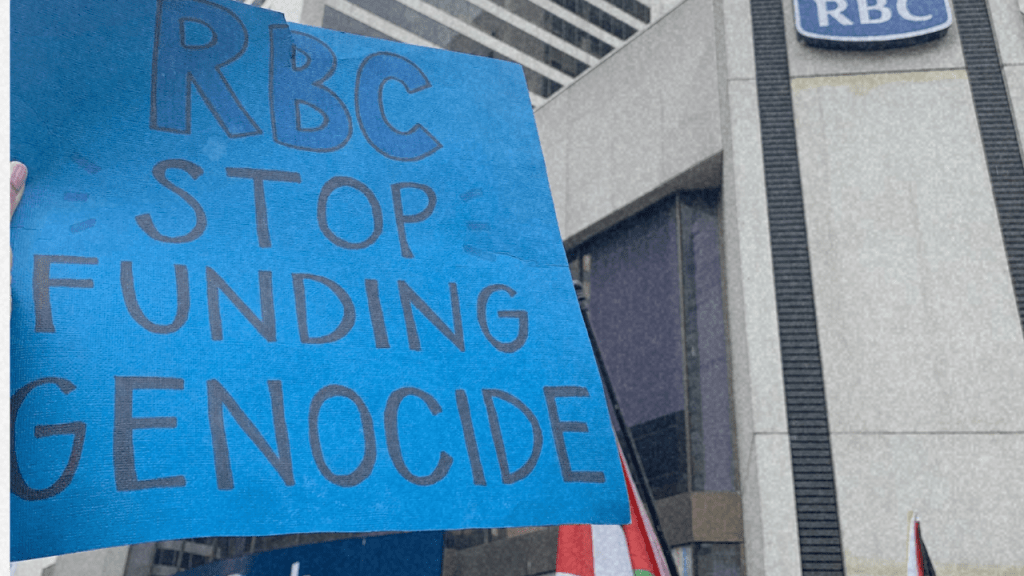
On Saturday, April 6, 2024, 42 coordinated actions swept across Turtle Island as organizers, land defenders, and community members gathered at Royal Bank of Canada branches from Vancouver to Ottawa to Halifax. The date was deliberate: Fossil Fools Day, five days before RBC’s Annual General Meeting in Etobicoke, where shareholders would assemble at the Toronto Congress Centre to receive the bank’s annual accounting of itself. The branch actions were designed to make clear, in as many cities and towns as possible, that the bank’s self-presentation as a climate-conscious institution with a commitment to Indigenous rights would be contested — loudly and in public — before executives took the stage.
The target was specific. RBC is Canada’s largest financier of fossil fuels and, according to the 2024 Banking on Climate Chaos report — a joint analysis by Rainforest Action Network, BankTrack, Oil Change International, and the Sierra Club — ranked seventh among the world’s dirtiest banks. The report documented US$256 billion in fossil fuel financing since the Paris Agreement in 2016, with more than US$28 billion directed to fossil projects in 2023 alone. Among those projects is the Coastal GasLink pipeline, a fracked gas conduit running through unceded Wet’suwet’en territory in northern British Columbia. All five clans of the Wet’suwet’en have unanimously opposed oil and gas pipelines on their territories and have issued multiple eviction notices to TC Energy, Coastal GasLink’s owner, and to the RCMP. RBC’s exposure to the project includes a co-financed $6.5 billion loan, $275 million in project finance, a $40 million corporate loan, and $200 million in co-financed working capital.
The pipeline’s construction proceeded not through consent but through court-ordered injunctions enforced by militarized police raids on Wet’suwet’en territory. In 2019, the RCMP raided the territory to enforce a civil injunction against anyone impeding construction. What followed was, in the words of an Amnesty International report cited by The Narwhal, a “years-long campaign of violence, harassment, discrimination and dispossession” against Wet’suwet’en land defenders. The bank provided the capital. The state provided the enforcement. The pipeline advanced.
A Coordinated Challenge
The Fossil Fools Day actions were organized through a coalition including Leadnow, Indigenous Climate Action, and allied organizations, with participating groups receiving organizer toolkits and support to stage visible actions at their local RBC branches. Over a thousand people participated across the 42 cities and towns, generating national and local media coverage that framed the upcoming AGM around questions of Indigenous rights and fossil fuel financing rather than the bank’s preferred narrative of incremental climate progress.
The tactical logic was straightforward: RBC’s AGM is a shareholder event with formal procedures and limited public access, but branches are dispersed across every community in the country. An action at a branch in Kingston or Regina or Barrie could not be dismissed as a Toronto problem or a activist fringe. Photos from the day showed crowds with banners reading “RBC: Racist Bank of Complicity” and “Canada’s #1 Fossil Bank.” The bank’s public image, carefully maintained through climate commitments and sustainability reports, was the explicit target.
The organizing framed the issue not narrowly as a climate question but as one of overlapping systems of extraction. Event materials from Leadnow and the Punch Up Collective explicitly connected RBC’s financing of the Coastal GasLink pipeline to its investments in tar sands extraction and to weapons and surveillance technology companies operating in Palestine. The Canadian BDS Coalition documented RBC’s holdings in companies listed on the UN database for complicity with violations of international law, including its investment in Palantir, which provides AI predictive systems to Israeli security forces. These connections were not incidental to the Fossil Fools Day framing — they were central to it.
Inside and Outside the AGM
When April 11 arrived, hundreds marched through rain to the Toronto Congress Centre. The rally outside featured speakers from Wet’suwet’en Land Defenders, the Palestinian Youth Movement, and Keepers of the Water, alongside Indigenous drumming and a 15-foot inflatable of RBC CEO Dave McKay. Participants marched around the building’s perimeter, met by a heavy police and private security presence.
Inside the meeting room, Indigenous and Black land defenders from across Turtle Island were met with interruptions, tight speaking limits, and what organizers described as censorship from the RBC board. This was not a new pattern. At the previous year’s AGM in Saskatoon, delegates had been manhandled and segregated amid increased police surveillance and private security — conduct that one commentator described at the time as apartheid. The 2024 meeting was less overtly violent but followed the same logic: Indigenous voices inside the room were to be managed, not heard.
Despite this, the pressure generated by the Fossil Fools Day mobilization and by sustained shareholder negotiations in the lead-up to the AGM produced formal concessions. Through engagement led by the Union of British Columbia Indian Chiefs (UBCIC) and the BC Government Employees Union (BCGEU), RBC agreed to amend its human rights statement to include the standard of Free, Prior, and Informed Consent (FPIC) — the internationally recognized principle under the UN Declaration on the Rights of Indigenous Peoples that Indigenous peoples must be able to give or withhold consent before projects affecting their territories proceed. The bank also agreed to expand its Environmental and Social Risk policy on Indigenous rights and to disclose its ratio of clean energy financing to fossil fuel financing in future climate reports.
Wet’suwet’en Hereditary Chief Na’Moks, who was present at the AGM, responded directly: “While RBC has added respecting Free Prior Informed Consent to its Human Rights statement, and expanded its Environmental and Social Risk policy on Indigenous rights, being true to that means never financing a project like Coastal Gas Link again. A pipeline that continues to threaten the freedoms and democracy of Indigenous peoples and all Canadians.”
Grand Chief Stewart Phillip of the UBCIC was equally measured: “RBC is not off the hook by any means. Policies are one thing but what matters is action. We will closely monitor RBC’s progress. Respecting FPIC is not an optional standard that only applies when consent is granted. It must also include the right to say ‘no’ and have that respected.”
The Limits of Concession
The formal commitments extracted from RBC at its 2024 AGM represent the result of years of sustained pressure — legal challenges, shareholder resolutions, physical occupations of pipeline routes, and the annual ritual of confronting the bank at its own shareholder meetings. They are not nothing. Inserting FPIC into a major bank’s human rights statement creates a documented standard against which its future financing decisions can be measured and challenged. The agreement to disclose its energy supply ratio gives organizers a new metric for tracking the gap between the bank’s rhetoric and its capital flows.
But the Coastal GasLink pipeline is built. The gas it carries will flow. The pipeline’s construction cost ballooned to $14.5 billion from an original estimate of $6.6 billion — largely due to delays caused by Indigenous resistance and ongoing protests — and TC Energy completed a $7.15 billion bond offering described at the time as the largest corporate bond offering in Canadian history. RBC’s co-financing of that project did not pause while the bank updated its policy statements.
What the April 2024 mobilization demonstrated was not that financial institutions can be reformed through public pressure alone, but that the convergence of Indigenous land defense, climate organizing, and solidarity movements across different fronts — including Palestinian liberation — constitutes a political formation that cannot be easily ignored by institutions dependent on public legitimacy. The Fossil Fools Day coalition’s framing — that RBC profits from land theft and war, ecocide and genocide — connected structures that liberal environmentalism typically keeps separate. That framing, and the organizing it produced, made the 2024 AGM a considerably less comfortable event for RBC than the bank had planned for.
The question of what RBC does with its new FPIC commitment — whether it applies it retroactively, whether it refuses financing for future projects that proceed without consent, whether it treats it as a genuine constraint or a reputational shield — will be answered not in policy documents but in capital allocation decisions. Land defenders on Wet’suwet’en territory, and those on the territories of the many other nations whose lands intersect with RBC-financed projects, have made clear they intend to hold the bank to account.
Sources
- Leadnow. “Fossil Fools Day and RBC’s 2024 AGM.” Leadnow.ca, April 17, 2024. https://leadnow.ca/rbc2024/
- Fossil Free RBC. “Canada Banking on Climate Chaos 2024.” Fossil Free RBC, May 13, 2024. https://fossilfreerbc.org/canada-banking-on-climate-chaos-2024/
- Fossil Free RBC. “Coastal GasLink.” Fossil Free RBC, January 2024. https://fossilfreerbc.org/projects/coastal-gaslink/
- Meyer, Carl. “RBC on defensive over fossil fuel critiques.” The Narwhal, June 19, 2024. https://thenarwhal.ca/royal-bank-fossil-fuels-reputation/
- Fossil Free RBC. “RBC on the defensive at its AGM as movement-led demands yield wins.” BankTrack, April 11, 2024. https://www.banktrack.org/article/rbc_on_the_defensive_at_its_agm_as_movementled_demands_yield_wins
- Punch Up Collective. “Fossil Fools Day.” Punch Up Collective, March 31, 2024. https://www.punchupcollective.org/reo-calendar/fossil-fools-day/
- Indigenous Climate Action. “Fossil Fools Day.” indigenousclimateaction.com, 2024. https://www.indigenousclimateaction.com/events/fossil-fools-day
- Canadian BDS Coalition. “RBC investments complicit with war crimes and corporate colonialism.” BDS Coalition, April 3, 2024. https://bdscoalition.ca/2024/04/02/rbc-investments-complicit-with-war-crimes-and-genocide/
- Union of British Columbia Indian Chiefs. “Investor Engagement Yields Major Changes to Indigenous Rights at Canada’s Largest Bank.” UBCIC, April 2024. https://www.ubcic.bc.ca/investor_engagement_yields_major_changes_to_indigenous_rights_at_canadas_largest_bank
- UN Office of the High Commissioner for Human Rights. “Consultation and Free, Prior and Informed Consent.” OHCHR. https://www.ohchr.org/en/indigenous-peoples/consultation-and-free-prior-and-informed-consent-fpic
- Patterson, Brent. “RBC segregated Indigenous peoples at its 2023 AGM.” Canada’s National Observer, June 15, 2023. https://www.nationalobserver.com/2023/06/15/opinion/rbc-segregated-indigenous-peoples-its-2023-agm
- Rainforest Action Network. “New Report: Canadian Bank RBC the #1 Financier of Fossil Fuels.” Rainforest Action Network, April 13, 2023. https://www.ran.org/press-releases/new-report-canadian-bank-rbc-the-1-financier-of-fossil-fuels-worlds-biggest-banks-continued-to-pour-billions-into-fossil-fuel-expansion/
 decolonize.ca
Leave a comment