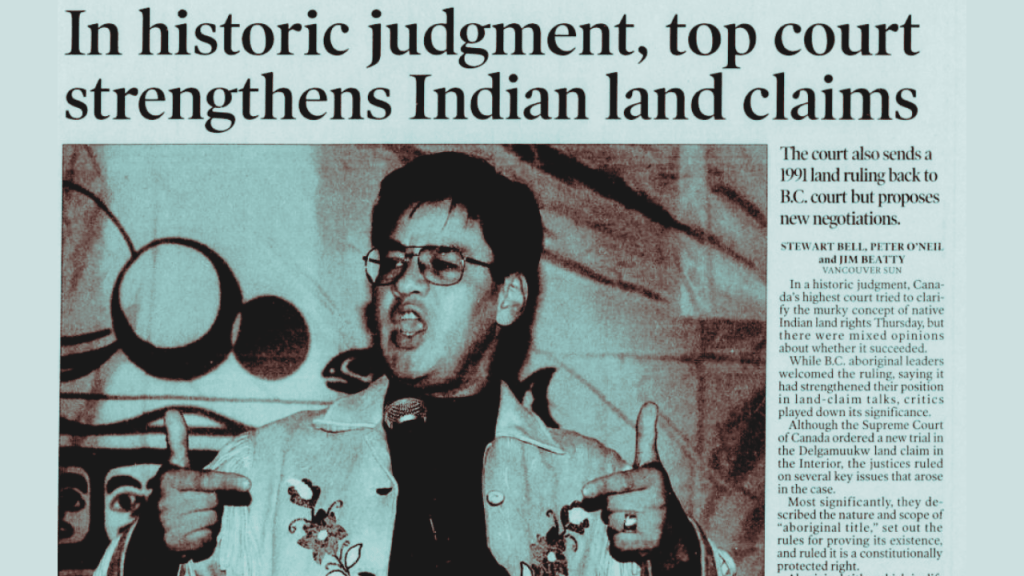
Delgamuukw decision recognized First Nations land rights in 1997, but decades later, Canada’s inaction highlights ongoing colonial injustice and broken promises.
On December 11, 1997, the Supreme Court of Canada issued its landmark decision in the Delgamuukw v. British Columbia case. This ruling recognized the validity of oral histories in establishing Aboriginal title and provided a comprehensive definition of title, which includes the right to exclusive use and occupation of land for purposes consistent with cultural attachment.
While the decision was a victory for the Gitxsan and Wet’suwet’en peoples, it stopped short of resolving their land claim, ordering a new trial that has yet to occur. The Delgamuukw decision became a symbol of Indigenous resistance and laid a legal foundation for future land claims, even as government inaction persisted.
1871: British Columbia Joins Confederation
The history of Indigenous struggles in British Columbia began long before the Delgamuukw decision. When British Columbia entered Canadian Confederation in 1871, it marked the start of systemic oppression for First Nations peoples in the region. The government swiftly enacted laws that criminalized Indigenous economic practices, such as commercial fishing, and disrupted traditional ways of life. A devastating smallpox epidemic in 1872 further decimated Indigenous populations along the coast.
The Indian Act and Residential Schools
In 1876, the federal government introduced the Indian Act, a colonial tool of oppression. This legislation prohibited cultural practices, ceremonies, and community gatherings, systematically dismantling Indigenous social structures.
By 1890, residential schools such as those in Kamloops and Williams Lake were operational, forcibly removing Indigenous children from their families, languages, and cultures. These institutions inflicted profound trauma that continues to affect Indigenous communities to this day.
Early 20th Century: Resistance Amid Oppression
Despite systemic barriers, Indigenous resistance persisted. After World War II, many First Nations veterans returned to Canada determined to fight for their rights. The pass system, which restricted Indigenous mobility, was abolished in 1945, and activism began to rise.
Anthropologist Harry B. Hawthorn’s 1966 report, A Survey of the Contemporary Indians of Canada, exposed the failures of assimilation policies and recommended treating Indigenous peoples as “citizens plus,” deserving of rights and resources for self-determination.
1973: The Calder Case
The Calder v. British Columbia (A.G.) case in 1973 was a watershed moment. Frank Calder and the Nisga’a Nation successfully argued that Aboriginal title existed before colonization. Though the Supreme Court’s decision was split on whether title had been extinguished, it forced the Canadian government to acknowledge Aboriginal title, paving the way for future land claims, including the Gitxsan and Wet’suwet’en’s Delgamuukw case.
The Gitxsan and Wet’suwet’en Legal Battle
In 1984, the Gitxsan and Wet’suwet’en peoples filed their landmark claim for 58,000 square kilometers of traditional territory. The case relied heavily on oral histories and traditional knowledge, which were initially dismissed as unreliable.
After years of litigation, the Delgamuukw decision on December 11th, 1997 validated these forms of evidence and set important legal precedents for Aboriginal title in Canada. However, the lack of concrete government action following the ruling left many unresolved issues.
The Coastal GasLink Pipeline and Modern Resistance
The struggle for land rights took center stage again in 2018 with the approval of the Coastal GasLink pipeline. The project, which cuts through Wet’suwet’en territory, proceeded without the consent of hereditary chiefs, sparking protests and blockades.
In December 2019, Wet’suwet’en hereditary chiefs rejected a court injunction allowing construction and issued an eviction notice to Coastal GasLink personnel. The Royal Canadian Mounted Police (RCMP) responded with force, and violence, dismantling blockades and arresting land defenders, leading to nationwide solidarity protests in early 2020.
Despite negotiations and a Memorandum of Understanding (MOU) signed in 2020 acknowledging Wet’suwet’en rights and title, the agreement failed to address the pipeline issue or provide significant legal changes. This left many Indigenous leaders and allies disappointed.
Recent Developments in Reconciliation and Policy Reform
In June 2023, the Government of Canada published a National Action Plan to implement the United Nations Declaration on the Rights of Indigenous Peoples (UNDRIP). Framed as a transformative effort with 180 commitments, the plan’s language of partnership starkly contrasts with the realities on the ground. Critics have labeled these commitments as performative gestures, highlighting Canada’s long history of promising change while continuing to prioritize settler and corporate interests over Indigenous sovereignty.
The government’s approach to settling First Nation land claims reveals the hollowness of its reconciliation rhetoric. While 56 specific claims were settled between April 2022 and April 2023 for $3.5 billion, these settlements often come with significant strings attached, such as the use of promissory estoppel, which prevents First Nations from pursuing further legal action.
This shift away from the outright “modern surrender” process may appear progressive, but it remains rooted in protecting Crown interests rather than empowering Indigenous self-determination. Efforts to create a fully independent claims process, while co-developed with the Assembly of First Nations, have yet to demonstrate meaningful structural change.
Budget Commitments and Ongoing Advocacy
The 2024 Canadian federal budget allocated $426 million for First Nations on reserves and $62 million for self-governing and modern treaty First Nations. While this funding is framed as a significant investment in reconciliation, these figures pale in comparison to the ongoing subsidies and legal protections provided to industries encroaching on Indigenous lands. Since 2015, the government touts $200 billion in Indigenous partnerships, yet much of this funding addresses basic infrastructure gaps—a far cry from substantive reparations or restitution.
Meanwhile, the UN special rapporteur on the rights of Indigenous peoples has criticized Canada for its failure to adhere to international standards, particularly regarding free, prior, and informed consent.
Large-scale projects like the Coastal GasLink pipeline, pushed forward without the consent of hereditary chiefs, exemplifies the Canadian government’s policy of continued prioritization of resource extraction over Indigenous rights.
The result is not reconciliation but escalating tensions, protests, and blockades. Far from addressing historical injustices, Canada’s actions perpetuate a cycle of colonial violence dressed in the language of progress.
Reflecting on Progress and Challenges
Twenty-seven years after the Delgamuukw decision, the fight for Indigenous land rights continues, but Canada’s efforts remain deeply flawed and often disingenuous. Initiatives like UNDRIP implementation and land claim policy reform are held up as signs of progress, but they often serve as distractions from the Canadian government’s failure to address the structural injustices that underpin colonial relationships. The gap between rhetoric and action grows wider each year, highlighting a systemic reluctance to fully recognize and uphold Indigenous sovereignty.
Canada’s reluctance is not a mere oversight but a deliberate strategy to maintain control over land and resources. Policies framed as reconciliation consistently prioritize settler economic interests over Indigenous rights, perpetuating the same colonial dynamics that the Delgamuukw decision sought to challenge.
Advocacy and resistance remain crucial not because of a lack of solutions, but because Canada has chosen to ignore them, leaving Indigenous peoples to continually fight for justice in a system designed to deny it.
For settlers, today should be a moment of reckoning, not just a reminder. Supporting Indigenous rights requires more than passive acknowledgment; it demands active dismantling of the colonial systems that benefit settlers at the expense of Indigenous peoples.
Canada’s relationship with its First Nations is mired in historical injustices that remain largely unaddressed, and the so-called progress since 1997 often feels like a performative exercise rather than genuine change. Reflecting on the past 27 years reveals a pattern of empty promises and symbolic gestures that fail to deliver meaningful justice or equity. The work is not only far from over—it has barely begun in any substantive sense.
On this anniversary, settler allies should recommit themselves to supporting Indigenous communities. Visit DecolonialSolidarity.ca for more information on how to get involved and show your support for the Wet’suwet’en resistance.
 decolonize.ca
Leave a comment